Journal
Gorilla, crocodile, bear: the bestiary of pop art décor
The gorilla, the crocodile, the bear, the bulldog. Each animal carries a different reading. A short guide to the pop art bestiary, from François Pompon to Jeff Koons.
Published on October 25, 2026 · 5 min read
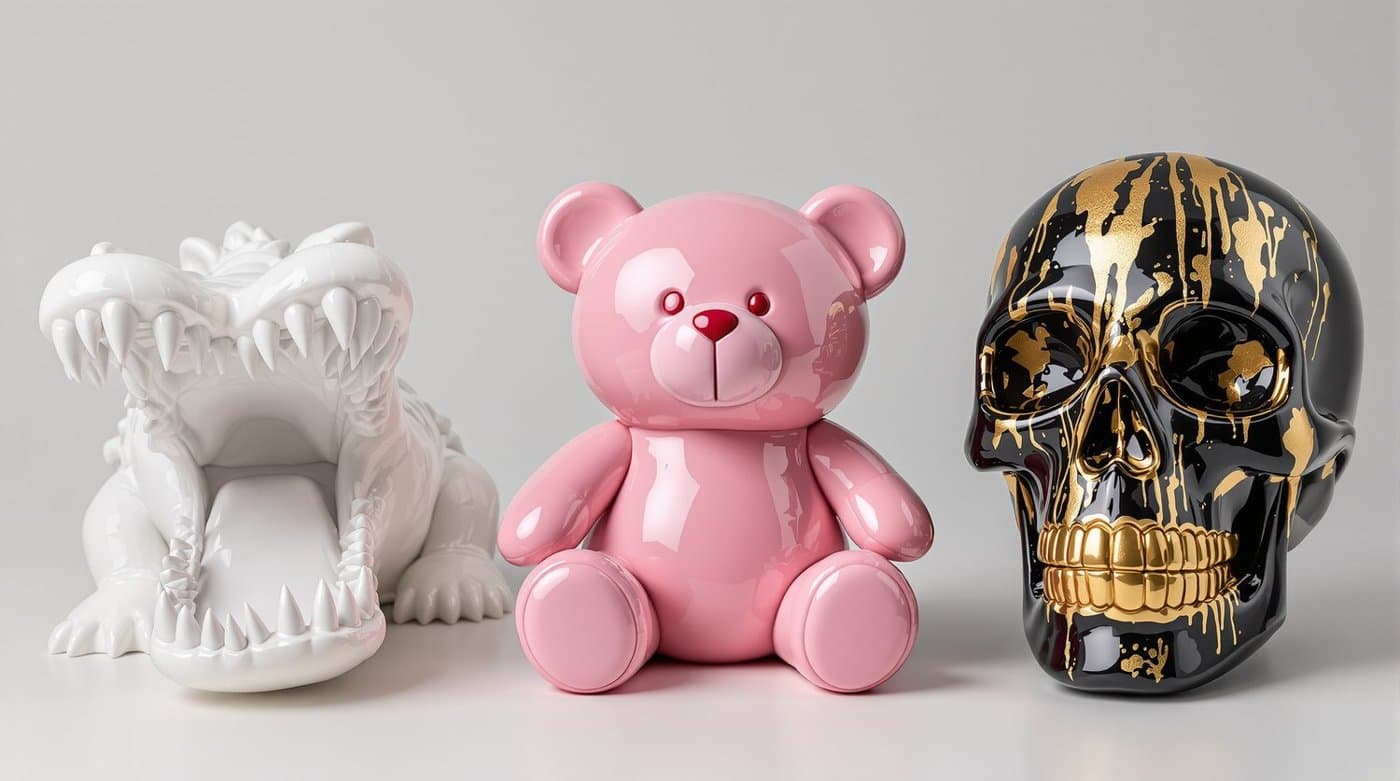
Animals hold a special place in decorative sculpture. Anyone can read them, without explanation. They carry centuries of symbolism. And they take bold finishes very well: a pink lacquer, a gold chrome, drips of paint. This bestiary looks at the subjects most often found in pop art décor and what they bring to an interior.
Why the animal rather than abstraction
An abstract sculpture asks the eye to make an effort of interpretation. An animal does not. We recognise it in a fraction of a second, which leaves all the room for surprise: the colour, the scale, the material. Pop art rests precisely on this gap between a familiar motif and an unexpected treatment.
A long tradition
The sculpted animal is nothing new. At the beginning of the 20th century, François Pompon was already simplifying animal forms down to their essentials. His « Polar Bear », shown at the Salon d'Automne in 1922, is now held at the Musée d'Orsay. Smooth, with no detail of fur, it heralds a modern way of treating the subject.
In the 1960s, François-Xavier Lalanne turned the animal into an object to live with: his sheep serve as seats, other creatures become furniture. Later, Jeff Koons pushed pop logic to its limit with his Balloon Dogs in mirror-polished stainless steel, coated with a layer of transparent colour. A fairground dog becomes a museum piece.
Animal sculptures in lacquered polyresin inherit these three ideas: Pompon's simplification, Lalanne's familiarity, Koons's brilliance.
The gorilla: quiet strength
The gorilla is probably the most requested subject. It evokes power, but power at rest. Seated, arms crossed or resting on the ground, it commands a calm presence. Popular culture, from King Kong onwards in cinema, has made it a figure at once menacing and touching.
In interiors, the gorilla works well in large volumes. Its vertical, massive silhouette holds its own against a double-height ceiling or a picture window. Three finishes radically change how it reads:
- Gold chrome. The gorilla becomes a precious object, almost a trophy. It catches the light and reflects it back.
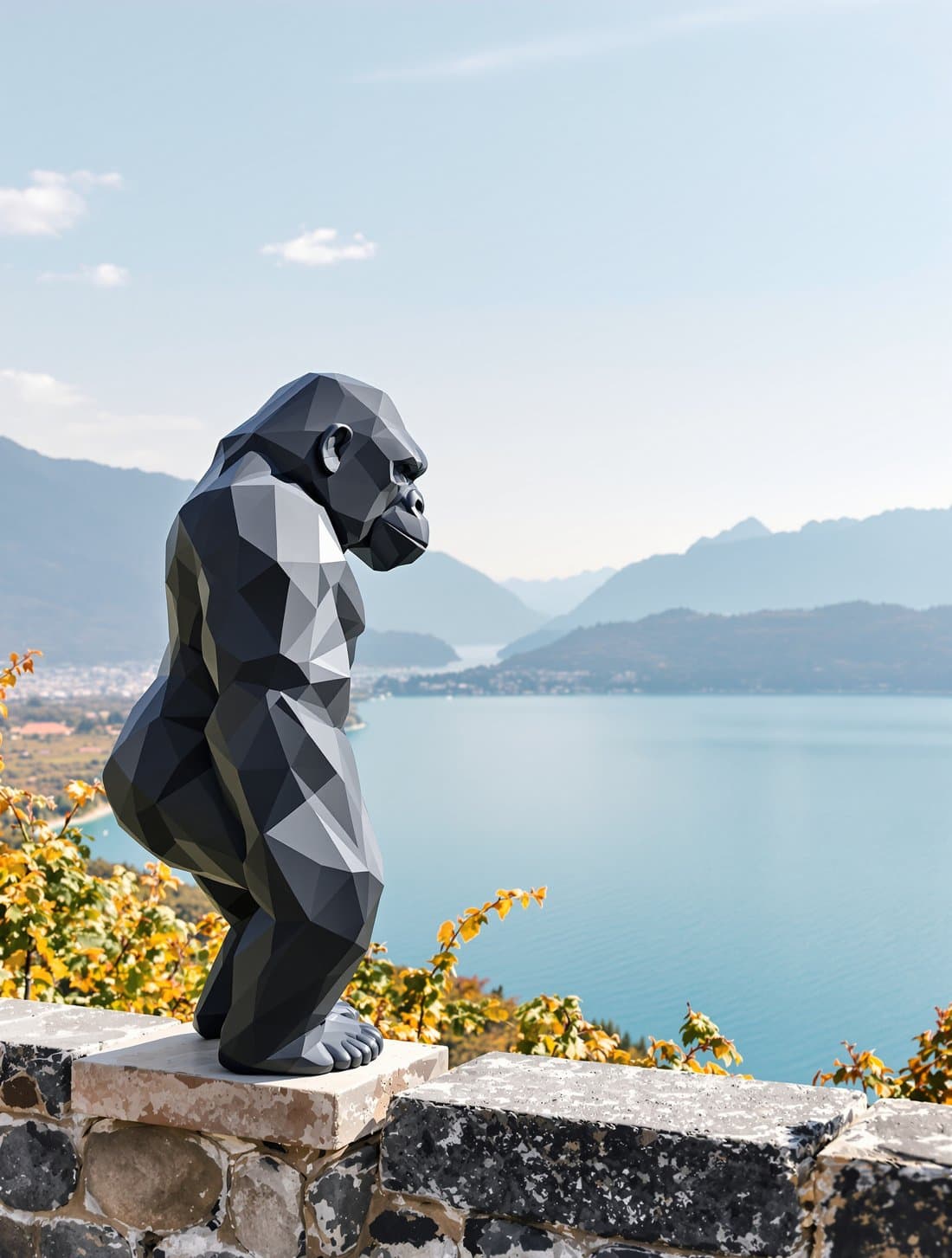
- Black facets. The surface, cut into planes close to the digital aesthetic known as low poly, turns the animal into a geometric volume. The Faceted gorilla, black, 100 cm reads as much as an architectural object as an animal.
- White and gold. A softer reading, suited to light interiors.
The crocodile: patience and irony
The crocodile is a horizontal animal. It makes its presence felt not through height but through length. Placed on the floor, it occupies a diagonal, runs along a wall, stretches out beneath a console table. It is a way of placing a strong sculpture without cluttering the field of vision.
Its symbolism is ancient. In ancient Egypt, the god Sobek had the head of a crocodile. In folk tales, it embodies patience and cunning. In white lacquer, it loses all aggression and takes on an almost abstract character: the shape of the jaws, the relief of the scales, the curve of the tail.
The Crocodile, white lacquer, 80 cm suits a medium-sized living room or entrance hall. The 120 cm version needs more distance and finds its place in long rooms or on a covered terrace.
The bear: gentleness and power
The bear is a paradox. Feared in the wild, it is also the animal of childhood par excellence, ever since the teddy bear appeared at the beginning of the 20th century. Pop art sculpture plays on both registers at once.
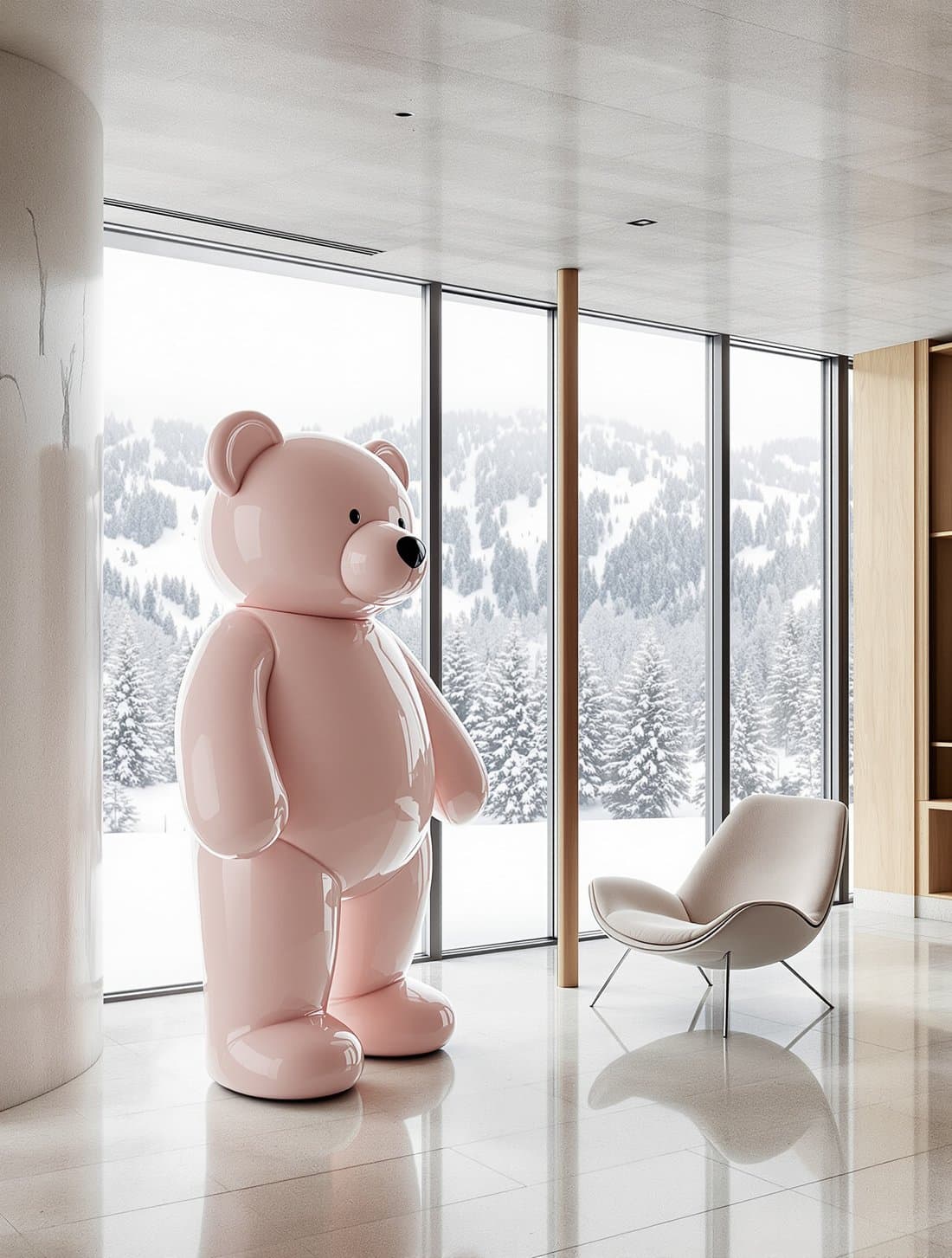
A pink lacquer heightens the contrast. The mass remains that of a predator, the colour evokes confectionery. The Bear, pink lacquer, 60 cm is a good example: at knee height, it converses with an armchair, a coffee table, a rug. It brings a note of lightness to a serious interior, without becoming childish.
The bulldog: character and humour
The bulldog is the companion animal of the bestiary. Smaller, closer, it sits happily on a piece of furniture or at the foot of a sofa. Its broad head and scowling expression give it immediate character. In the British imagination, it is associated with tenacity.
Two finishes, two temperaments. In matt black, it becomes a graphic, understated silhouette. In drip, it gains colour and energy. The Bulldog, drip, 50 cm draws the eye in a study or a library, where a larger piece would be too much.
The shark: menace tamed
The shark holds a singular place in contemporary art. In 1991, Damien Hirst exhibited a tiger shark preserved in a tank of formaldehyde, under the title « The Physical Impossibility of Death in the Mind of Someone Living ». The work made the shark a symbol of fear and of death held at a distance.
A sculpted shark head takes up this idea in a lighter key. Isolated, jaws open, it is part trophy, part quotation. In a drip finish, the menace dissolves into colour. It is a piece for terraces, games rooms, spaces where humour has its place.
The skull: the vanitas revisited
The skull is not an animal, but it belongs to the same repertoire. Since the vanitas paintings of the Flemish and Dutch schools of the 17th century, it has been a reminder of life's brevity. Andy Warhol devoted a series of paintings to it in the 1970s. In 2007, Damien Hirst presented « For the Love of God », a platinum skull set with diamonds.
A 40 cm skull in a gold drip finish takes up this dialogue between gravity and luxury. Small, it sits on a shelf, a console table, a desk. It brings a dark, precious note without dominating the room.
How to choose your animal
A few simple criteria help you decide:
- The shape of the space. A tall space calls for a gorilla. A long space calls for a crocodile. A piece of furniture calls for a bulldog or a skull.
- The desired atmosphere. The gorilla commands. The bear softens. The bulldog amuses. The skull questions.
- The finish. The same creature changes character depending on whether it is lacquered, chromed, matt or drip. To go further, read our guide to choosing a pop art sculpture for your living room.
- Coexistence. Two animals can converse in the same room, provided you vary the sizes and keep a shared finish or similar colours.
See the bestiary in person
The presence of a sculpted animal depends on its scale and its material, two things a photograph conveys poorly. Each vernissage lasts two days at the Aubonne hall, staged as a gallery. ArtPop's animals are presented there as exceptional pieces, sculpted by hand and painted by hand. On Friday and Saturday, it is open to all; members of the Club discover the pieces 48 hours beforehand.