Journal
Drip paint: the story of a finish that became iconic
For a long time, a paint drip was a flaw. With Jackson Pollock, it became a gesture. With contemporary design, a finish.
Published on October 28, 2026 · 5 min read
For centuries, a paint drip was a mistake. The house painter avoided it; the easel painter corrected it. In the mid-20th century, it became an artistic gesture in its own right. Today, it covers sculptures, objects and clothing. A look back at the history of a finish now simply called drip.
Before Pollock: chance as a tool
The idea of letting the material act on its own did not emerge overnight. Between the wars, the Surrealists were already interested in chance and automatic processes. In the early 1940s, Max Ernst experimented with a technique in which a perforated tin filled with paint was swung above a canvas laid flat. The path of the paint traced lines that the painter controlled only in part.
In New York, at the same time, other artists were exploring similar avenues. Janet Sobel, a self-taught painter, exhibited canvases covered in networks of fine lines in the mid-1940s, which several critics have since linked to what was to follow.
Jackson Pollock and drip painting
It was Jackson Pollock who turned the drip into a method and a signature. Between roughly 1947 and 1950, in the barn he had converted into a studio in Springs, on Long Island, he painted his best-known canvases, leaving the easel behind.
The method
Pollock laid the canvas directly on the floor. He moved around it, worked from all four sides, and let the paint run, drip or splash using sticks, hardened brushes or straight from the tin. He used industrial paints in particular, enamels and lacquers intended for buildings or cars, which were more fluid than traditional oil paint.
The English term dripping, from to drip, became the established name for the technique. Pollock himself insisted on the control he exercised: the drip was not an accident but a controlled gesture, one in which the whole body took part.
Key works
Among the best-known canvases of this period are "Lavender Mist" (1950), held at the National Gallery of Art in Washington, and "Autumn Rhythm (Number 30)" (1950), at the Metropolitan Museum of Art in New York. Their surface is made of superimposed layers of lines and spots, with no centre and no hierarchy.
The image of a gesture
In 1950, the photographer Hans Namuth photographed and filmed Pollock at work. These images played a considerable role: they showed the public that painting could be an action, almost a performance. In 1952, the critic Harold Rosenberg coined the term "action painting" to describe this approach, associated with Pollock and other Abstract Expressionist painters.
From gesture to popular culture
After Pollock, the drip was never quite a flaw again. It became a sign, recognisable to all, evoking energy, spontaneity and a certain freedom.
Street art
Graffiti adopted the drip in its own way. An overloaded spray can lets paint run down a wall. What was once clumsiness became a deliberate effect, used on lettering and murals.
Fashion and design
From the 2000s onwards, paint drips multiplied on trainers, clothing, furniture and objects. The word drip itself entered English slang to describe a look, a confident personal style. This double meaning, technical and cultural, partly explains the popularity of the finish.
Drip applied to sculpture
On a canvas laid flat, paint spreads. On a sculpture, it runs. That is the whole difference. Gravity guides the drips from top to bottom, follows the volumes, gathers in the hollows and stretches across smooth surfaces.
What the finish reveals
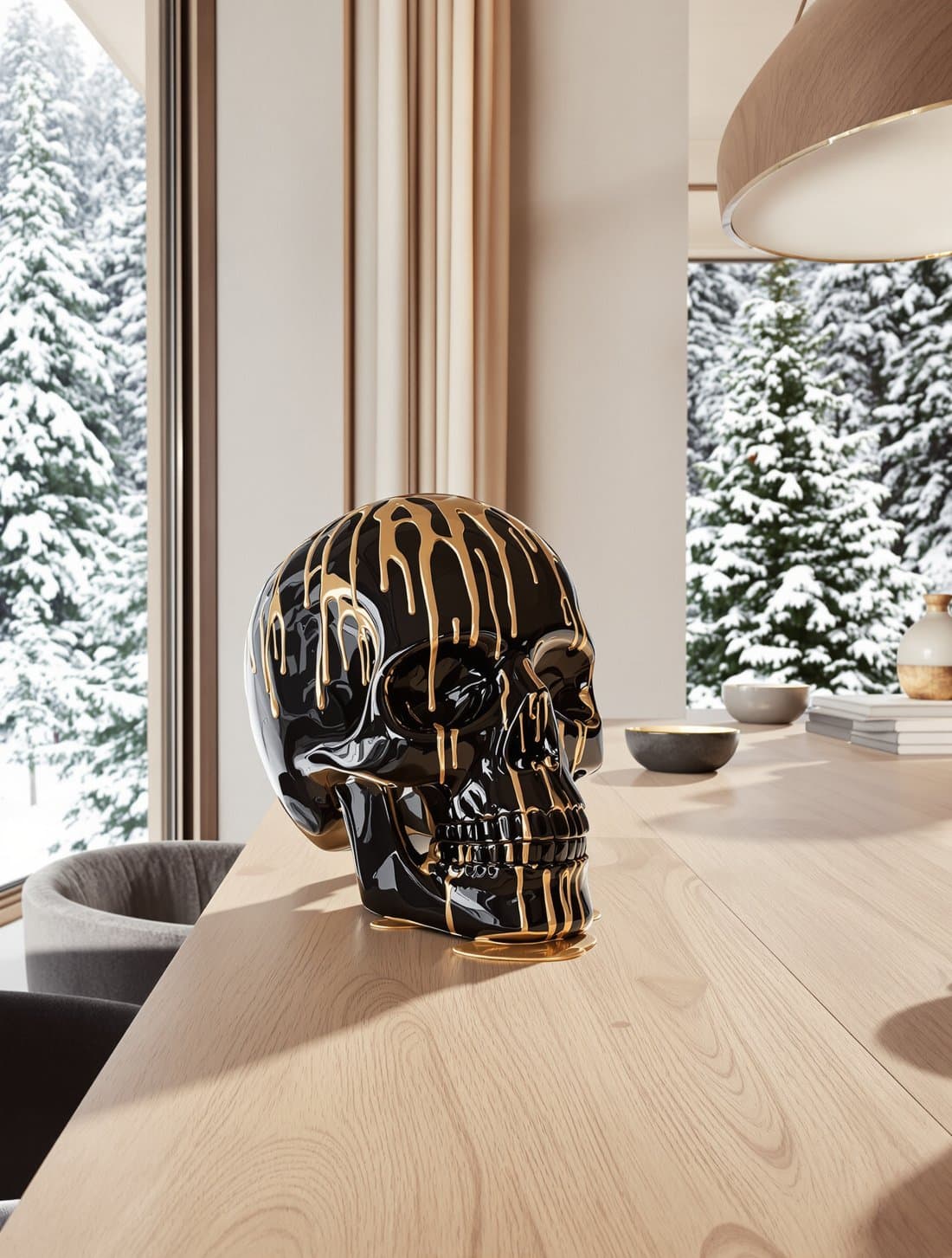
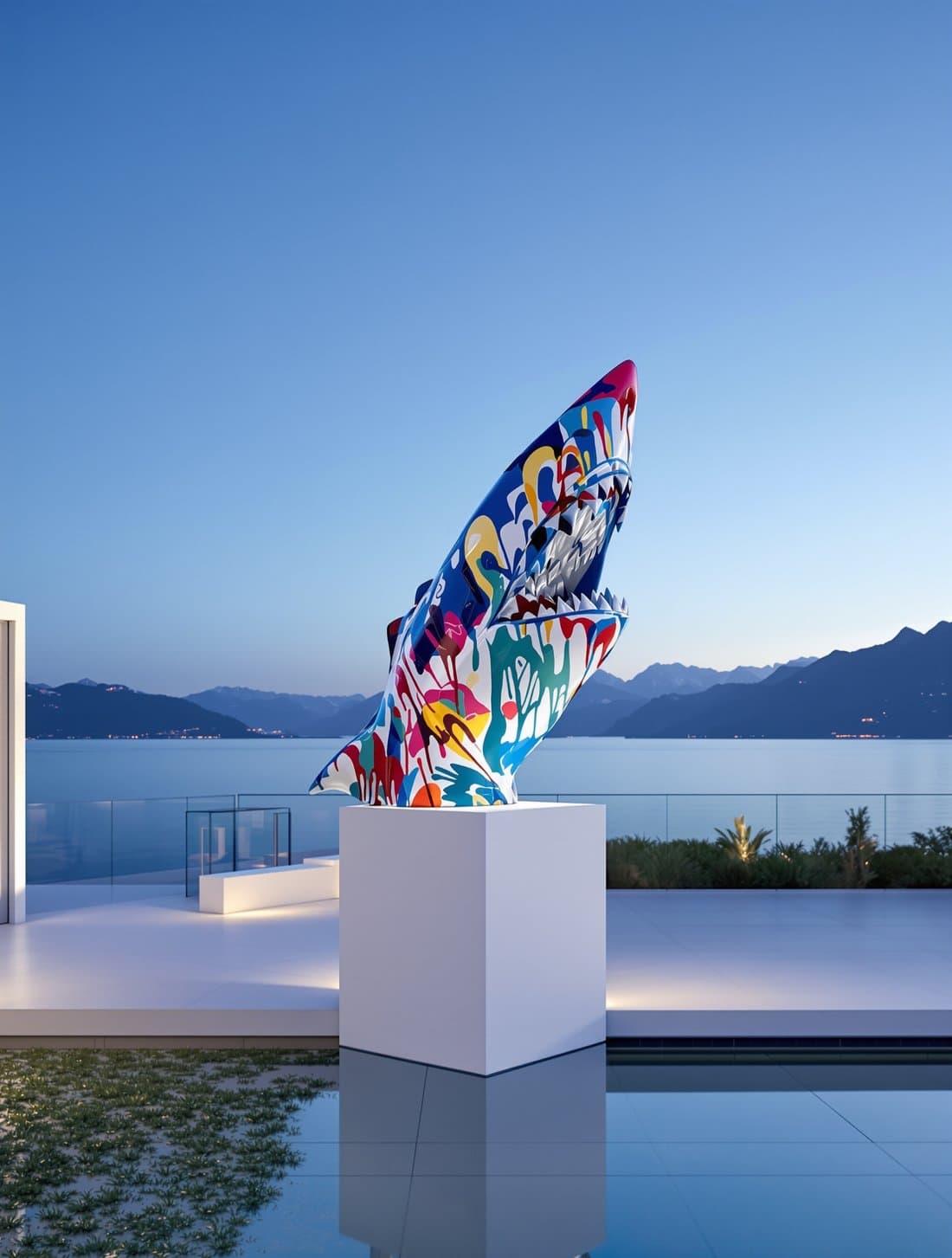
Drip emphasises form. On a shark head, the drips follow the curve of the snout and tighten around the teeth. On a skull, they slide down from the crown and outline the eye sockets. On a bulldog, they disappear into the folds of the neck. The surface tells the story of how the paint travelled across the volume.
Colour and base
A drip finish usually combines a base colour with one or more drip colours. A dark base makes bright drips stand out. A metallic base, gold for example, gives a more precious effect. The Skull, gold drip, 40 cm plays in this register, somewhere between vanitas and luxury object.
An element of chance
On ArtPop pieces, the drips are painted by hand. No two pieces are ever strictly identical. The overall form is the same, but the position and length of each drip vary. That is one of the appeals of the finish: you choose a piece, not just a model.
Three drip pieces, three readings
- The Shark head, drip, 80 cm. The most striking subject. The colour defuses the menace and turns the trophy into a pop object. It suits a covered terrace, a games room, a large bare wall.
- The skull, gold drip, 40 cm. The most compact format. It finds its place on a console table, a shelf, a desk. The gold lends it a gravity that the drips lighten.
- The Bulldog, drip, 50 cm. The most familiar. The drip reinforces its character and its humour.
Placing a drip sculpture well
Drip is a busy finish. It needs space to be read.
- A calm background. A plain wall, white, grey or black, shows off the drips. Avoid patterned wallpaper or a crowded shelf directly behind.
- Soft, side lighting. It brings out the relief of the drips, which form a slight raised layer.
- One drip piece per space. Two finishes this expressive in the same field of view cancel each other out. Pair the drip with a plain lacquered piece instead, in white or black.
- The right height. Smaller formats are best seen up close, at eye level.
For placement in general, our guide to choosing a pop art sculpture for your living room sets out the key points on size and light.
Care
The surface of a drip finish has relief. Dust it with a soft brush or a microfibre cloth, without rubbing hard on the ridges of the drips. No solvents, no abrasive products.
Seeing the drips up close
The relief of a drip, the depth of a varnish, the way light catches the raised layers: these are details that photography flattens. The drip pieces from each vernissage are shown for two days at the Aubonne hall, on Friday and Saturday, open to all. Members of the Club discover them 48 hours earlier.