Journal
Decorating a chalet or villa in Switzerland with a contemporary sculpture
A timber chalet and a villa overlooking Lake Geneva do not call for the same sculpture. A few principles for choosing and placing a contemporary piece in each.
Published on October 27, 2026 · 5 min read
A Swiss house often asserts its character before a single object has been placed in it. The timber of a chalet, the stone of a renovated farmhouse, the large picture windows of a villa facing Lake Geneva or the Alps. A contemporary sculpture should not fight that character. It should answer it. Here is how to go about it, according to the type of house and room by room.
The principle: contrast rather than imitation
In a chalet, the temptation is to stay within the Alpine register: carved wood, horns, mountain animals. The result is coherent, but rarely surprising. A pop art sculpture takes the opposite approach. It introduces a smooth, glossy material into a setting of raw materials, a bold colour into a palette of browns and greys.
This contrast works because each register enhances the other. Wood looks warmer beside a cool lacquer. Lacquer looks crisper beside a weathered log. The same reasoning applies to a contemporary villa: very pared-back architecture benefits from an organic form, an animal, a silhouette.
In a chalet
The materials at play
The traditional chalet is built of solid timber, often spruce or larch, sometimes with stone for the base and the fireplace. Ceilings are lower than in town, windows smaller, light scarcer in winter. Renovated chalets often open up the space beneath the roof structure and enlarge the windows.
What works
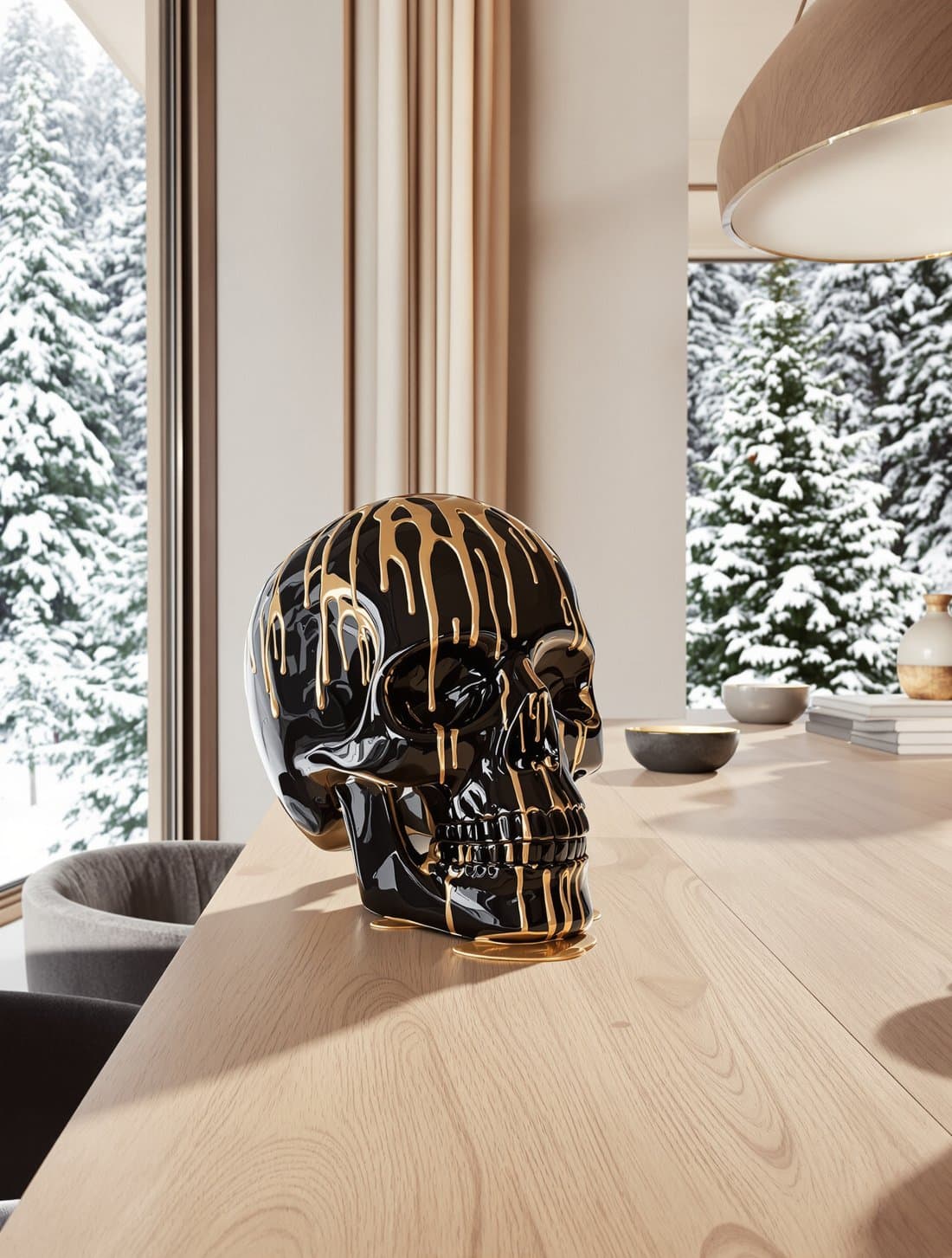
- Small and medium formats. In a chalet with low ceilings, a piece of 40 to 60 cm placed on a piece of furniture or on the floor near the fireplace finds its place easily. The Skull, gold drip, 40 cm on an old wooden sideboard creates a clear contrast between patina and gloss.
- Warm finishes. Gold, pink and off-white respond well to the tones of the wood. Cool chrome also works, but it needs directed lighting so as not to look dull in a dark room.
- Spaces beneath the rafters. If the living room opens up to the ridge, a large format finally has the space it needs. A 100 cm gorilla at the foot of a wooden staircase fills the height without cluttering the floor.
Constraints to anticipate
Heating a chalet in winter dries the air considerably, and the temperature difference between inside and outside is significant. A lacquered resin sculpture is generally less sensitive to these variations than solid wood, but avoid placing it against a stove, a radiator or a fireplace in use. Direct heat can mark a lacquer.
Access matters too. A snowy path, a narrow staircase, a low doorway: measure the way in before choosing a large format. For handling and moving, our article on polyresin and fibreglass sets out a few simple rules.
In a villa
The materials at play
The contemporary Swiss villa, on La Côte, in Lavaux or on the heights above Geneva, often relies on light: large picture windows, pale stone or concrete floors, white walls, a view of the lake or the mountains. The volumes are generous, the ceilings high, the circulation fluid.
What works
- Large formats. This is the natural territory for pieces of 80 to 120 cm. A white-lacquered crocodile placed along a picture window extends the horizontal line of the lake. A vertical gorilla answers a double-height space.
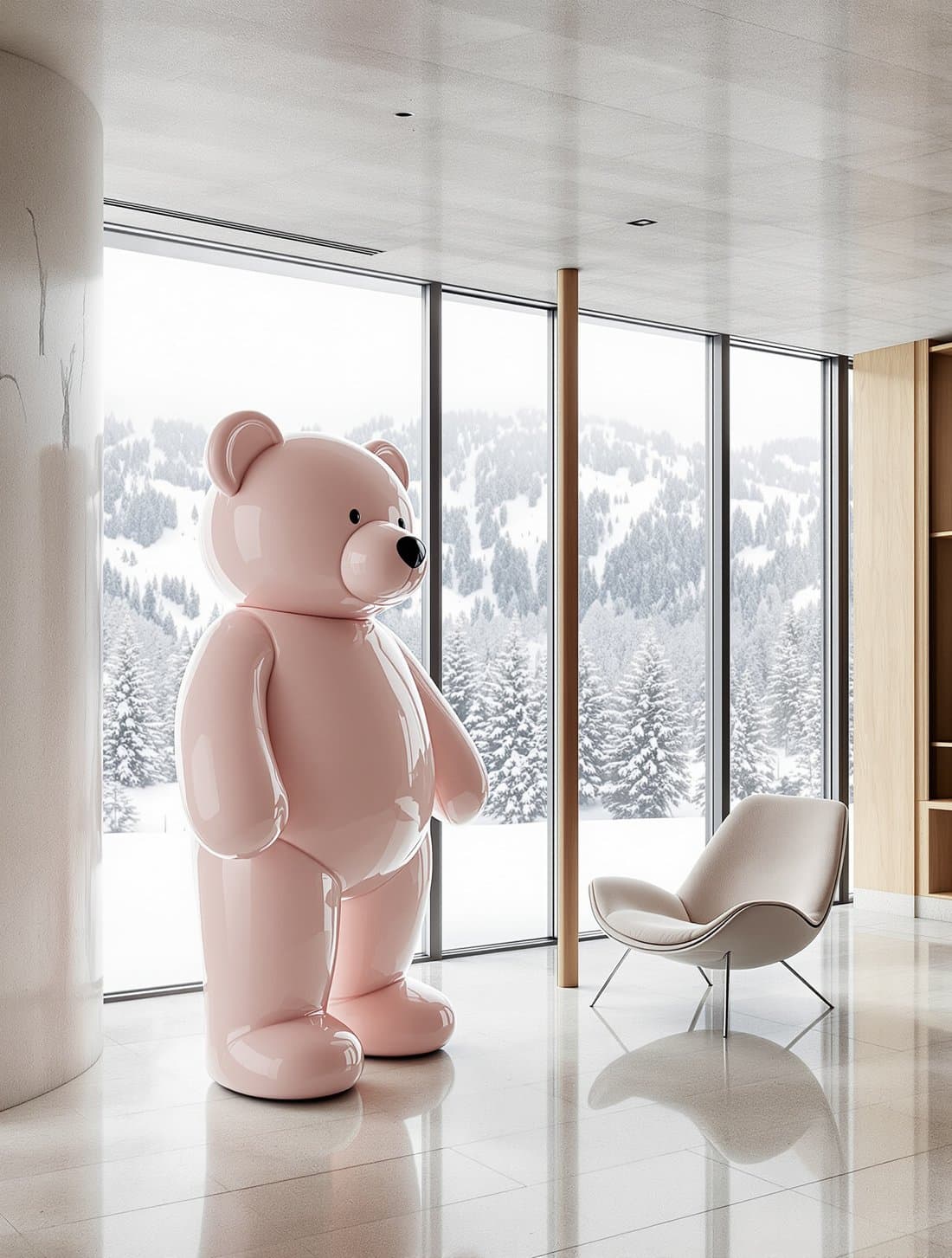
- Bold colour. In a white, mineral interior, a single coloured piece is enough to create a focal point. The Bear, pink lacquer, 60 cm in front of a window opening onto the Alps plays on the gap between the landscape and the object.
- Reflections. Chrome and gold make the most of natural light. The Gorilla, gold chrome, 100 cm reflects the landscape as much as it stands out against it.
Constraints to anticipate
Light is an asset, but long hours of direct sun can, over time, cause certain colours to fade. Position the piece so that it benefits from the light without sitting in full sun all day. Behind a large south-facing window, stepping it back slightly is often enough.
Room by room
The entrance hall
This is the first glimpse of the house. A sculpture placed opposite the door sets the tone. In a chalet, opt for a medium format on a piece of furniture. In a villa, a larger floor-standing piece welcomes the visitor.
The living room
As the main living space, it readily takes the strongest piece. In a chalet, near the fireplace or in a corner. In a villa, in dialogue with the view, or conversely with its back to the window so that it can be seen from outside.
The staircase and landings
Landings are often overlooked. A medium-sized sculpture creates a visual pause there and brings life to a space people pass through.
The covered terrace
It extends the living room in fine weather. Some pieces belong there, provided they are protected from rain, direct sun and frost. At altitude, bring the sculpture indoors for the winter.
The study
A small format, a skull or a bulldog, on a bookcase or the corner of a desk, adds a touch of character without distracting.
Lighting according to the house
In a chalet, natural light is often weak in winter. An adjustable spotlight or lighting recessed into a beam brings out the lacquer and gives the sculpture presence in the evening. In a villa, make the most of daylight and add grazing light for the evening, when the windows turn into black mirrors.
One piece or several
In a chalet, one strong piece per space is generally enough. The setting is already rich. In a large villa, several sculptures can converse from one room to the next, provided a sense of coherence is kept: one family of finishes, or one colour register. Two gorillas in different finishes, one in the entrance hall and one in the living room, create a common thread.
Choosing in person
The scale of a sculpture is hard to judge on a screen, especially when it is intended for a particular space. Take the measurements of the spot, a few photos of the room, and come and see the sculptures at the Aubonne hall. Each vernissage there lasts two days, Friday and Saturday, open to all; members of the Club see it 48 hours earlier. The pieces, hand-painted, are collected on site only: for a large format intended for a chalet, come with a suitable vehicle. To help you decide between formats, our guide to choosing a statement piece sets out the size benchmarks.